
Maritime Broadband Communication
Coast-Link™ is a broadband maritime communication concept developed by us. Using modern 4G wireless technology, dedicated bandwidth can be provided for many different applications over long distances. Ships are connected through a network of base stations located along coastlines and offshore platforms. Whether for internet or intranet access, VPN, or VoIP – Coast-Link™ provides reliable broadband wireless connectivity within a defined coastal region.
General Challenge
Until a few years ago, radio links were mostly fixed and location-based systems. In 2010 we started developing our Coast-Link™ wireless concept to analyze and improve connectivity for ships. At that time, there were no existing systems specifically designed for maritime broadband communication. Therefore, a complete concept had to be developed from scratch – from the wireless connection on the ship, to special network mechanisms, and even a dedicated data center infrastructure.
The solution allows ships to move within a defined sector while maintaining a stable connection to the harbor. This is possible because of our special antenna design, which compensates for the movement and rotation of the ship. With this technology, ships can be connected up to a distance of 50 km from the base station.
This is made possible by using a licensed frequency band. Ships can therefore stay continuously connected with broadband access around their home port or along a coastal route. The necessary radio and operating licenses are provided by the network operator dasNetz AG.
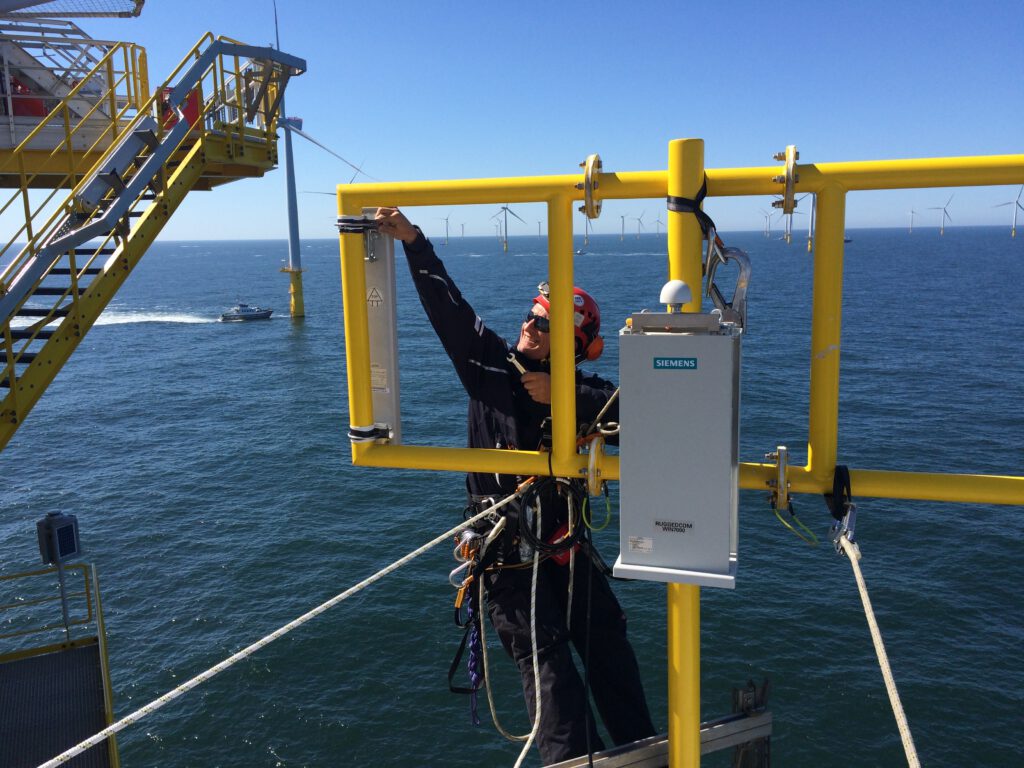
However, the wireless connection does not need to be limited to a single harbor. The long-term goal is to provide coverage across the entire German Exclusive Economic Zone. For this purpose, base stations are also installed on offshore wind farm platforms.
Challenge Scandlines
The Hamburg-based ferry operator Scandlines GmbH runs several ferry routes in the Baltic Sea between Germany, Denmark, and Sweden. The focus is on high service quality and an enjoyable onboard experience, as well as extensive shopping opportunities in the BorderShops on land. Our challenge was to provide internet connectivity for Scandlines ferries with 20 Mbps bandwidth at a distance of up to 48 km between the coast and the ships, especially in areas where conventional communication systems have limited coverage.
The goal was to improve offshore communication efficiency and connectivity to the central database, while also simplifying and improving electronic payment processes. A reliable broadband connection with unlimited data and low latency was required to support Voice-over-IP telephony, EC cash terminals, onboard hotspots, and connections to administrative computers. After the conversion to hybrid ferries, the onboard battery systems are now also integrated into online monitoring via Coast-Link™.
Challenge Global Health Care
In a medical emergency at sea, the nearest doctor is often far away. In such situations, the ship’s captain may have to head to the nearest port or arrange a rescue by ship or helicopter. In both cases, valuable time is lost before the patient receives initial medical treatment. Currently, communication on ships usually relies on satellite connections. The satellite antenna compensates for the ship’s movement by automatically aligning with the satellite transponder. However, for a sea rescue cruiser that must handle strong waves and severe storms, conventional satellite antennas cannot always guarantee a stable connection suitable for telemedicine. In addition, limited bandwidth and long delays create major challenges for users.
A joint project between Global Health Care, Siemens, and Coast-Link™ provides a solution. Global Health Care delivers the telemedicine technology, while Wireless.Consulting GmbH is responsible for planning and implementing the Coast-Link™ communication infrastructure.
Solution
A network of base stations already provides full coverage for our services in many areas. A multiple-layer wireless infrastructure enables different services for different customer groups. Hybrid usage is also supported through our scalable Coast-Link™ onboard unit. For backup or load balancing, multiple transmission paths can be routed through the Coast-Link™ onboard unit. The Coast-Link™ onboard unit is available in two different hardware versions, both equipped with the same operating system and full software functionality.