Exploring the Potential of the 5G Mobile Standard Using Autonomous Monorail Vehicles
“5G SIMONE” (secure.mobile.connected with 5G) is a research project funded by the 5G.NRW innovation program. The program supports innovative 5G projects to accelerate digital transformation in North Rhine-Westphalia. One focus of the project is the networking of autonomous transport systems such as the MonoCab.
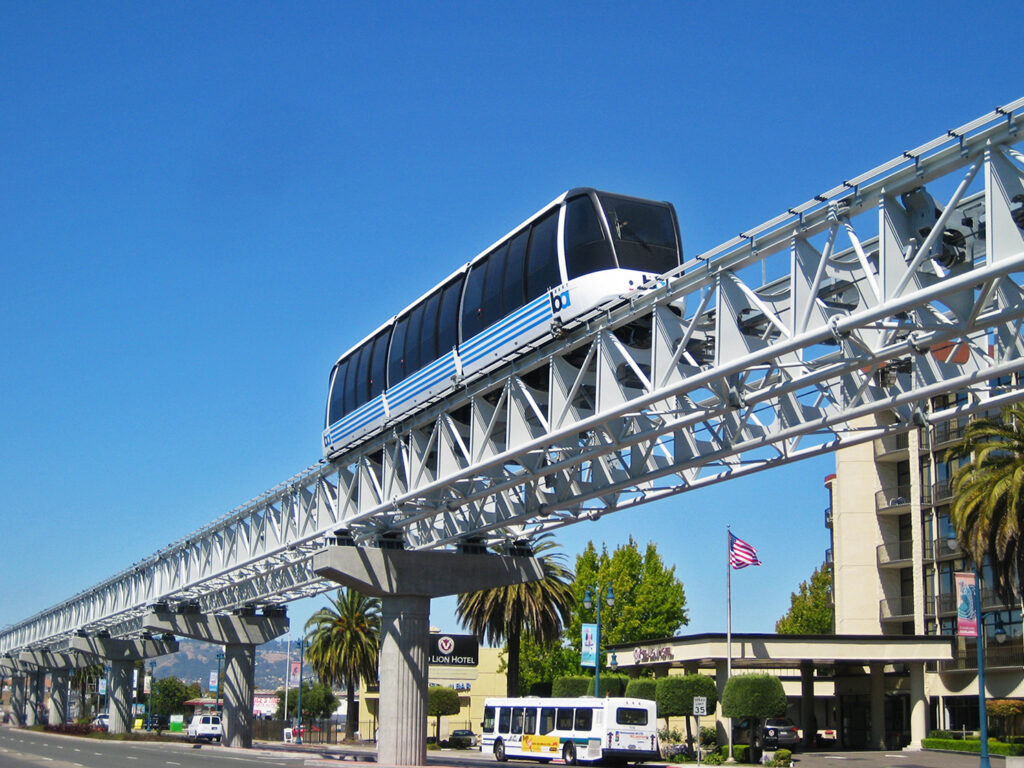
These innovative monorail vehicles are designed to operate on unused railway tracks and help make public transport more attractive again. The vehicles are battery-powered and operate automatically, with the long-term goal of fully autonomous driving. Such transportation systems could represent a major step toward more efficient, faster, and reliable mobility solutions.
The Goal of 5G SIMONE: Efficient Operation Through 5G Connectivity
The automated monorail vehicle will be connected using 5G technology to enable efficient and comfortable railway operations. This includes real-time networking of vehicle controllers, communication with the environment to detect potential hazards early, communication with the control center, communication between vehicles, and the transmission of high-resolution video streams.
Within the project, the 5G network and its services are being tested as a unified platform for multiple applications. The deployment of 5G services follows a hybrid approach. On one side, a private 5G standalone campus network provided by Fraunhofer IOSB-INA is used. On the other side, the public 5G network of Deutsche Telekom is integrated.
The project investigates how well both the private 5G campus network and the public 5G infrastructure perform under different requirements and transmission scenarios. It also creates an experimental foundation for future services and innovative mobility solutions.
The Challenge
The vehicles are connected to both the private and public 5G networks. After implementing the network infrastructure, different applications are integrated into the system.
These include perception technologies such as high-resolution cameras and LiDAR sensors, the transmission of real-time controller data between vehicles, and real-time communication with the external control center. To ensure reliable operation, the entire communication path must support extremely low latency and minimal jitter in both directions.
Existing wireless networking solutions and 4G technology cannot sufficiently meet the strict latency and reliability requirements of such applications.
Additional Technical and Scientific Goals
The findings of this project are intended to support other closed-loop control applications. “We expect the research results to have multiple benefits, including applications in other industries,” explains Sebastian Schriegel, Head of the Industrial Communication Group at Fraunhofer IOSB-INA in Lemgo.
The combination of the “MONOCAB OWL” and “5G SIMONE” projects also allows the research teams to combine expertise in IoT, image processing, interoperability, safety, and security to develop future mobility technologies.